Skin Essentials Chocolate Drink Mix, read ingredient by ingredient
Is the 500 mg of NMN in Skin Essentials a trial dose? It sits between two doses that raised blood NAD+
Does the NMN in Skin Essentials match the trials? Its 500 mg sits between two doses that raised blood NAD+ in a 60-day trial of 80 adults, and its 5 g of creatine is a tested dose.
Reader-supported: this page has affiliate links to Renue By Science. If you buy through them we earn a commission, which funds our research. We choose what to cover independently. How we’re funded
Article info
Evidence: 9 papers, 9 human studies.
Research and article information
How we made this. Checked against every study we cite. It is not medical advice.
Updated:
How we check · Methodology · Is NMN legal in US supplements? · Corrections · How we’re funded
Six-minute walk distance rose more than on placebo at all three NMN doses, with the longest walks at 600 and 900 mg a day
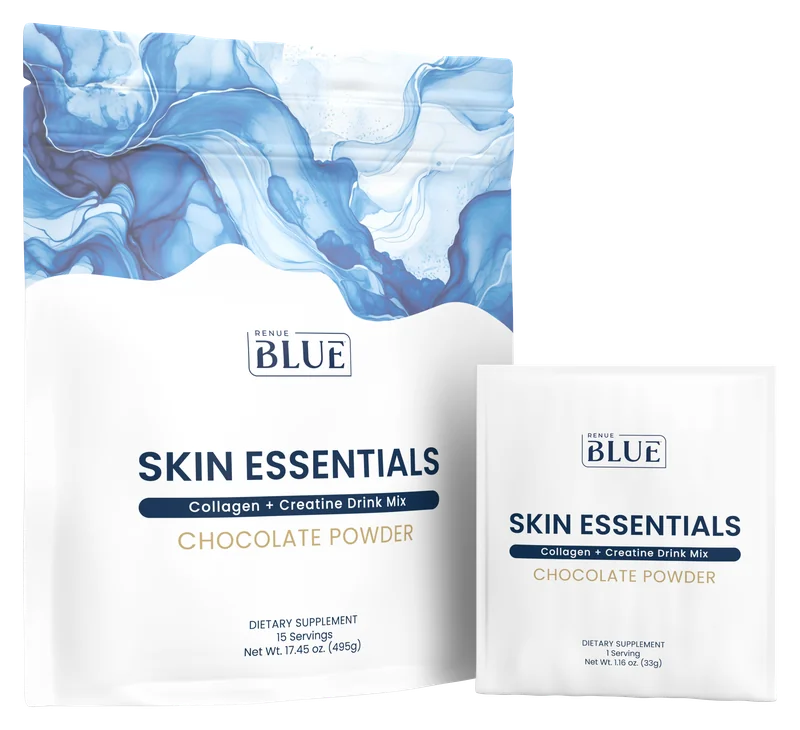
One 33 g pouch holds 500 mg of nicotinamide mononucleotide (NMN), a direct precursor to NAD+. That sits between the 300 and 600 mg daily doses that both raised blood NAD+ versus placebo in a 60-day trial of 80 healthy middle-aged adults (Yi 2023); no trial we found tested exactly 500 mg. The pouch’s 5 g of creatine monohydrate is the daily amount that raised muscle creatine in a 14-day trial of healthy young adults (Askow 2022). The other three labeled ingredients, collagen peptides 12 g, liposomal vitamin C 1,000 mg and TMG (trimethylglycine) 500 mg, had no paired trial in our evidence, so we state them as amounts only.
What we checked
We took Renue’s own label for the Skin Essentials Chocolate Drink Mix, ingredient by ingredient, and matched each amount to the published human trials (from PubMed) that tested that ingredient at a nearby daily amount. We then read the label the way a reader would: amount per ingredient, servings per pack, and form. We did not look at whether the pouch works as a combined drink: no trial tested this exact combination.
The label, per 33 g serving:
- Collagen peptides: 12 g
- Creatine monohydrate: 5 g
- Nicotinamide mononucleotide (NMN): 500 mg
- Liposomal vitamin C: 1,000 mg
- TMG (trimethylglycine): 500 mg
- “plus other ingredients”
Each 33 g pouch carries 15 g of protein and 90 kcal (label). A pack is 15 single-serve pouches (495 g). Renue says the drink “supports skin hydration, elasticity, and firmness.”
500 mg of NMN: between doses that raised blood NAD+
NMN is the NAD+ ingredient in the pouch. In the four trials below that measured it, daily NMN from 250 mg to 2,000 mg raised blood NAD+ or an NAD+ marker versus placebo, and two of them also found better walking results than placebo. No trial we found tested exactly 500 mg a day, so we place the pouch’s amount among the doses that were tested (see the table below):

- 300, 600 or 900 mg a day for 60 days in 80 healthy middle-aged adults raised blood NAD+ at every dose versus placebo, highest at 600 and 900 mg; six-minute walk distance rose more than on placebo at all three doses, and NMN was safe and well tolerated up to 900 mg a day (Yi 2023).
- 1,000 mg once or twice a day for 14 days in 32 overweight or obese adults aged 55 to 80 gave substantial, dose-related rises in blood NAD+ and was well tolerated (Pencina 2023).
- 250 mg a day for 12 weeks in 36 healthy middle-aged adults raised an NAD+ marker (serum nicotinamide) versus placebo, with a trend toward lower arterial stiffness that did not reach significance, and no adverse events (Katayoshi 2023).
- 250 mg a day for 12 weeks in 60 older adults raised blood NAD+ versus placebo, shortened 4-meter walk time and improved sleep-quality scores, with no adverse effects; the primary outcome, a stepping test, did not differ (Morifuji 2024).
- 250 mg a day for 12 weeks in 108 older adults: the afternoon NMN group showed the largest effect sizes for sit-to-stand speed and drowsiness, though the placebo groups also improved over time (Kim 2022).
- 300, 600 or 1,200 mg a day for 6 weeks in 48 recreational runners training five to six times a week: oxygen uptake and power at the ventilatory thresholds rose more than on placebo at 600 and 1,200 mg; VO2max did not change (Liao 2021).
- 250 mg a day for 24 weeks in 14 men aged 65 or older with diabetes and reduced grip strength or walking speed was safe but did not improve grip strength or walking speed versus placebo (Akasaka 2023).
So the pouch’s 500 mg sits between the 300 and 600 mg doses in the Yi trial, both of which raised blood NAD+ and walking distance versus placebo, and below the 1,000 mg once-daily dose in Pencina. That places it inside the tested range; it is not itself a tested dose, so we do not claim a 500 mg result.
The trial amounts and what each measured:
| Study | Design | People | Dose / duration | Result | Grade |
|---|---|---|---|---|---|
| Yi 2023 | RCT | 80 healthy middle-aged | 300, 600, 900 mg / 60 days | Blood NAD+ rose at every dose vs. placebo, highest at 600 and 900 mg; six-minute walk distance up more than placebo; safe to 900 mg | A |
| Pencina 2023 | RCT | 32 overweight or obese adults 55-80 | 1,000 mg once or twice daily / 14 days | Substantial, dose-related rise in blood NAD+; well tolerated | A |
| Katayoshi 2023 | RCT | 36 healthy middle-aged | 250 mg / 12 weeks | NAD+ marker (serum nicotinamide) higher vs. placebo; trend toward lower arterial stiffness, not significant; no adverse events | A |
| Morifuji 2024 | RCT | 60 older adults | 250 mg / 12 weeks | Blood NAD+ higher vs. placebo; shorter 4-m walk time; better sleep-quality scores; primary stepping test unchanged; no adverse effects | A |
| Kim 2022 | RCT | 108 older adults | 250 mg / 12 weeks | Largest effect sizes for sit-to-stand and drowsiness in the afternoon NMN group; placebo groups also improved | A |
| Liao 2021 | RCT | 48 recreational runners | 300, 600, 1,200 mg / 6 weeks (training 5-6x/week) | Oxygen uptake and power at the ventilatory thresholds rose more than placebo at 600 and 1,200 mg; VO2max unchanged | A |
| Akasaka 2023 | RCT | 14 men 65+ with diabetes and reduced physical performance | 250 mg / 24 weeks | Grip strength and walking speed did not differ from placebo; no severe adverse events | A |
| Askow 2022 | RCT | 29 healthy young men and women | 5 g / 14 days (with resistance exercise) | Muscle creatine content rose with creatine monohydrate, not with placebo or a creatine-leucine compound | A |
| Tarnopolsky 2001 | RCT | 19 untrained men | 10 g with glucose after exercise / 8 weeks (resistance training) | Strength gains similar to a protein-carbohydrate comparator; greater rise in total body mass | A |
5 g of creatine: the amount a trial used to raise muscle creatine
The pouch also carries 5 g of creatine monohydrate. A 14-day trial used that daily amount, and an older training trial used a higher one:
- 5 g a day for 14 days in 29 healthy young adults raised muscle creatine content with creatine monohydrate, but not with placebo or a creatine-leucine compound; participants also did supervised resistance exercise three times a week (Askow 2022).
- 10 g of creatine with glucose after exercise, over 8 weeks of resistance training in 19 untrained men, gave strength gains similar to a protein-carbohydrate comparator, with a greater rise in total body mass (Tarnopolsky 2001).
Figure 1. NMN sits one step from NAD+ in the salvage pathway, the main route cells use to keep NAD+ topped up.
Source: Covarrubias et al., Nature Reviews Molecular Cell Biology, 2021 (PubMed 33353981).
So the pouch’s 5 g matches the daily amount the Askow trial used.
The other three amounts: label facts only
Three ingredients on the pouch we state as amounts, with no research claim attached:
- Collagen peptides 12 g: a label amount. We did not find a paired trial in our evidence to compare it here.
- Liposomal vitamin C 1,000 mg: a label amount, stated as Renue lists it.
- TMG (trimethylglycine) 500 mg: a label amount, with no paired trial in our evidence.
What we can’t check
- No trial tested this exact five-ingredient combination together.
- No trial randomized exactly 500 mg of NMN a day; the pouch amount falls between tested doses, so we do not interpolate a 500 mg result.
- Both creatine trials had participants doing resistance training; the pouch is a drink, not a training program.
- We found no paired trial for collagen peptides, liposomal vitamin C or TMG at these amounts.
- No trial in our evidence tested the drink’s skin wording (hydration, elasticity, firmness); that is Renue’s description, not a measured result.
Who should check first: the trials above enrolled adults, mostly healthy, so people who are pregnant or breastfeeding or under 18 were not studied, and anyone on a prescription medicine or living with a medical condition should check with a clinician first.
Figure 2. The molecule is the same in every form; the form changes the dose format, convenience and cost per dose. Few human trials compare forms head to head.
Source: Healthspan Post, from product labels.
A short checklist for any multi-ingredient label
- Amount per ingredient, in one serving.
- Whether each amount falls inside the range the human trials tested.
- Servings per pack.
- Form (powder, capsule, drink mix).

The product we read
The Skin Essentials Chocolate Drink Mix comes as 15 single-serve 33 g pouches (495 g). Each pouch holds 500 mg of NMN, between the 300 and 600 mg daily doses in the Yi trial, and 5 g of creatine monohydrate, the daily amount in the Askow trial, alongside 12 g of collagen peptides, 1,000 mg of liposomal vitamin C and 500 mg of TMG. Renue says the drink “supports skin hydration, elasticity, and firmness.” See the Skin Essentials Chocolate Drink Mix at renuebyscience.com.
9 studies published from 2001 to 2024; the largest human study had 108 people
Show the data behind this chart
| Study | Year | People (n) | Grade | In humans |
|---|---|---|---|---|
| Yi 2023 | 2023 | 80 | A | Yes |
| Pencina 2023 | 2023 | 32 | A | Yes |
| Katayoshi 2023 | 2023 | 36 | A | Yes |
| Morifuji 2024 | 2024 | 60 | A | Yes |
| Kim 2022 | 2022 | 108 | A | Yes |
| Liao 2021 | 2021 | 48 | A | Yes |
| Akasaka 2023 | 2023 | 14 | A | Yes |
| Askow 2022 | 2022 | 29 | A | Yes |
| Tarnopolsky 2001 | 2001 | 19 | A | Yes |
Figure 3. Every study cited in this article, by year published and number of people studied. Color shows the evidence grade.
Source: Healthspan Post analysis of the 9 studies cited in this article (PubMed).
The studies ran from 2 weeks to 12 weeks
Pencina 2023 1,000 mg once or twice a day
2 weeksMeasured: blood NAD+ and its metabolome
Yi 2023 300, 600 or 900 mg a day
60 daysMeasured: blood NAD+, six-minute walk
Morifuji 2024 250 mg a day
12 weeksMeasured: blood NAD+, 4-m walk time, sleep
Katayoshi 2023 250 mg a day
12 weeksMeasured: serum nicotinamide, arterial stiffness
Kim 2022 250 mg a day
12 weeksMeasured: sit-to-stand, drowsiness, sleep
Figure 4. The dose each human trial used and how long it lasted, as its abstract reports. Longer bars mean longer trials.
Source: Healthspan Post summary of the cited trials (PubMed).
Show the scienceStudy-by-study table: 9 studies, design, dose and grade
The evidence
Every study cited in this article. Grades: A human RCT or meta-analysis.
| Study | Design | People | Dose / duration | Result | Grade | Source |
|---|---|---|---|---|---|---|
| Yi 2023[1] | RCT | 80 healthy middle-aged adultsn = 80 | 300, 600 or 900 mg/day · 60 days | Blood NAD+ rose at every dose versus placebo, highest at 600 and 900 mg; six-minute walk distance rose more than on placebo; safe and well tolerated to 900 mg/day | A | PubMed 36482258 |
| Pencina 2023[2] | RCT | 32 overweight or obese adults aged 55-80n = 32 | 1,000 mg once or twice daily · 14 days | Substantial, dose-related rise in blood NAD+; well tolerated | A | PubMed 35182418 |
| Katayoshi 2023[3] | RCT | 36 healthy middle-aged adultsn = 36 | 250 mg/day (125 mg twice daily) · 12 weeks | Serum nicotinamide (an NAD+ metabolite) higher versus placebo; trend toward lower arterial stiffness, not significant; no adverse events | A | PubMed 36797393 |
| Morifuji 2024[4] | RCT | 60 older adultsn = 60 | 250 mg/day · 12 weeks | Blood NAD+ and its metabolites higher versus placebo; 4-m walk time shorter; better sleep-quality scores; primary stepping test did not differ; no adverse effects | A | PubMed 38789831 |
| Kim 2022[5] | RCT | 108 older adultsn = 108 | 250 mg/day · 12 weeks | Afternoon NMN group had the largest effect sizes for sit-to-stand (d = 0.72) and drowsiness (d = 0.64); placebo groups also improved over time | A | PubMed 35215405 |
| Liao 2021[6] | RCT | 48 young and middle-aged recreational runnersn = 48 | 300, 600 or 1,200 mg/day · 6 weeks | While training 5-6 times a week, oxygen uptake and power at the ventilatory thresholds rose more than on placebo at 600 and 1,200 mg; VO2max did not change | A | PubMed 34238308 |
| Akasaka 2023[7] | RCT | 14 men aged 65 or older with diabetes and reduced grip strength or walking speedn = 14 | 250 mg/day · 24 weeks | Grip strength and walking speed did not differ from placebo; no severe adverse events | A | PubMed 36443648 |
| Askow 2022[8] | RCT | 29 healthy young men and women doing resistance exercise 3 times a weekn = 29 | 5 g/day · 14 days | Muscle creatine content increased with creatine monohydrate, not with placebo or a creatine-leucine compound | A | PubMed 36007881 |
| Tarnopolsky 2001[9] | RCT | 19 young, healthy, untrained menn = 19 | 10 g creatine monohydrate + 75 g glucose after exercise · 8 weeks | With resistance training, strength gains were similar to a protein-carbohydrate comparator, with a greater rise in total body mass | A | PubMed 11740297 |
Questions readers ask
How much NMN is in one pouch?
One 33 g pouch holds 500 mg of NMN. No trial we found tested exactly 500 mg a day; in a 60-day trial of 80 healthy middle-aged adults, 300, 600 and 900 mg a day all raised blood NAD+ versus placebo, so the pouch's amount sits between two tested doses. Source PubMed 36482258
Did NMN change walking in the 60-day dose trial?
In a 60-day trial of 80 healthy middle-aged adults, six-minute walk distance rose more on 300, 600 and 900 mg a day than on placebo, with the longest walks at 600 and 900 mg. Source PubMed 36482258
Does 5 g of creatine raise muscle creatine?
In a 14-day trial of 29 healthy young adults, 5 g a day of creatine monohydrate raised muscle creatine content; placebo and a creatine-leucine compound did not. Participants also did supervised resistance exercise three times a week. Source PubMed 36007881
Was NMN well tolerated in the trials?
In a 60-day trial of 80 healthy middle-aged adults, NMN at up to 900 mg a day raised no safety issues and was well tolerated. No trial tested this five-ingredient drink; anyone pregnant, breastfeeding, under 18 or on a prescription medicine should check with a clinician first. Source PubMed 36482258
*These statements have not been evaluated by the Food and Drug Administration. This product is not intended to diagnose, treat, cure, or prevent any disease.
Support our research
References
View all 9 cited studies
- Yi L, Maier AB, Tao R, et al. (2023). The efficacy and safety of β-nicotinamide mononucleotide (NMN) supplementation in healthy middle-aged adults: a randomized, multicenter, double-blind, placebo-controlled, parallel-group, dose-dependent clinical trial. Geroscience. PubMed 36482258
- Pencina KM, Lavu S, Dos Santos M, et al. (2023). MIB-626, an Oral Formulation of a Microcrystalline Unique Polymorph of β-Nicotinamide Mononucleotide, Increases Circulating Nicotinamide Adenine Dinucleotide and its Metabolome in Middle-Aged and Older Adults. J Gerontol A Biol Sci Med Sci. PubMed 35182418
- Katayoshi T, Uehata S, Nakashima N, et al. (2023). Nicotinamide adenine dinucleotide metabolism and arterial stiffness after long-term nicotinamide mononucleotide supplementation: a randomized, double-blind, placebo-controlled trial. Sci Rep. PubMed 36797393
- Morifuji M, Higashi S, Ebihara S, et al. (2024). Ingestion of β-nicotinamide mononucleotide increased blood NAD levels, maintained walking speed, and improved sleep quality in older adults in a double-blind randomized, placebo-controlled study. Geroscience. PubMed 38789831
- Kim M, Seol J, Sato T, et al. (2022). Effect of 12-Week Intake of Nicotinamide Mononucleotide on Sleep Quality, Fatigue, and Physical Performance in Older Japanese Adults: A Randomized, Double-Blind Placebo-Controlled Study. Nutrients. PubMed 35215405
- Liao B, Zhao Y, Wang D, et al. (2021). Nicotinamide mononucleotide supplementation enhances aerobic capacity in amateur runners: a randomized, double-blind study. J Int Soc Sports Nutr. PubMed 34238308
- Akasaka H, Nakagami H, Sugimoto K, et al. (2023). Effects of nicotinamide mononucleotide on older patients with diabetes and impaired physical performance: A prospective, placebo-controlled, double-blind study. Geriatr Gerontol Int. PubMed 36443648
- Askow AT, Paulussen KJM, McKenna CF, et al. (2022). Creatine Monohydrate Supplementation, but not Creatyl-L-Leucine, Increased Muscle Creatine Content in Healthy Young Adults: A Double-Blind Randomized Controlled Trial. Int J Sport Nutr Exerc Metab. PubMed 36007881
- Tarnopolsky MA, Parise G, Yardley NJ, et al. (2001). Creatine-dextrose and protein-dextrose induce similar strength gains during training. Med Sci Sports Exerc. PubMed 11740297