NMN side effects, daily use and long-term safety
Are there NMN side effects? In human trials, NMN was well tolerated
Worried about NMN side effects? In human trials of up to 24 weeks, NMN was well tolerated; in a 4-week trial, 1,250 mg a day caused no changes beyond normal variation. Multi-year use is still open.
This page has affiliate links to Renue By Science: we earn a commission if you buy through them.
Article info
Evidence: 8 papers, 6 human studies, 2 reviews of human studies.
Research and article information
How we made this. Checked against every study we cite. It is not medical advice.
Updated:
How we check · Methodology · Is NMN legal in US supplements? · Corrections · How we’re funded

The evidence
8
studies behind this article
6 human studies · 2 reviews of human studies
Bottom line
On NMN side effects, the human trials give a reassuring short-term answer: in the trials we read, NMN was well tolerated, and in a placebo-controlled trial of 31 adults, 1,250 mg a day for up to four weeks caused no changes beyond normal variation in blood, urine and body measures. The open question is multi-year use: the trials we found ran up to 24 weeks.
What we checked
- Lab result vs label
- 100.1% of the NMN on the label. Lot 072827576, Summit Nutritional Laboratories
- Cost per 500 mg
- $0.27 Median across Renue's NMN range: $0.92
- Where it sits in Renue's NMN range, cost per 500 mg
This product Same-molecule products Median $0.92 · USD per 500 mg · Prices checked November 22, 2026
Products and prices
- NMN Pure Powder: $0.27
- NMNs Fast Dissolve Tabs: $0.92
- NMN Liposomal Capsules: $1.44
- NMN Resveratrol Gel: $1.78
- Human studies in this article
- 6 4 randomized trials (study design grade A)
COA reviewed October 10, 2026: we read the certificates of analysis Renue publishes; we don't run lab tests ourselves. Every report we checked · Price index
How did the trials measure NMN side effects?
When a buyer asks “are there NMN side effects?” or “is NMN safe for long-term use?”, the answer comes down to what the trials tracked: adverse events, withdrawals and liver enzymes (ALT and AST) (Yang 2026), and standard blood, urine and body-composition panels (Fukamizu 2022). The trials gave NMN once or twice a day (Pencina 2023), and the daily doses ran wide, from 250 mg to 2,000 mg (Yang 2026). Most of the trials below also measured NAD+ or its metabolites (NAD+ is the coenzyme NMN helps cells make), so we can see the safety picture and the measured result together, without treating a blood marker as a felt effect.
“Did anyone in the trials get side effects?”
In a randomized, double-blind, placebo-controlled trial of 31 healthy adults aged 20 to 65, NMN was given at 1,250 mg once a day for up to four weeks. The result was reassuring: NMN did not produce changes beyond normal physiological variation in the blood, urine and body-composition measures, and no severe adverse events were observed (Fukamizu 2022).
A 60-day trial of 80 healthy middle-aged adults, randomized to placebo or 300, 600 or 900 mg a day, found no safety issues; NMN was well tolerated up to 900 mg, blood NAD+ rose at every dose (highest at 600 and 900 mg), and six-minute walking distance rose more than on placebo (Yi 2023).
Figure 1. The molecule is the same in every form; the form changes the dose format, convenience and cost per dose. Few human trials compare forms head to head.
Source: Healthspan Post, from product labels.
In a 14-day trial of 32 overweight or obese adults aged 55 to 80, an NMN formulation (MIB-626) at 1,000 mg once or twice daily was well tolerated, the frequency of adverse events was similar across the NMN and placebo groups, and blood NAD+ rose in a dose-related way (Pencina 2023).
“Is it ok to take NMN every day?”
The trials gave NMN every day, which is how the safety picture is built. A 12-week trial of 36 healthy middle-aged adults, randomized to 250 mg a day or placebo, found NMN well tolerated with no adverse events (Katayoshi 2023). In an eight-week single-arm trial, 11 healthy middle-aged Japanese men took 250 mg a day; it was well tolerated, and NAD+ in their blood cells rose over the weeks (Yamaguchi 2024).
The one limit to name here is duration: the longest trials in a 2026 pooled review ran 24 weeks (Yang 2026), so daily use for a year or more is not covered by the trials we found. That is the open question, not a result that came back negative.
Figure 2. NMN sits one step from NAD+ in the salvage pathway, the main route cells use to keep NAD+ topped up.
Source: Covarrubias et al., Nature Reviews Molecular Cell Biology, 2021 (PubMed 33353981).
“Does NMN cause flushing like niacin?”
Niacin, another NAD+ precursor, can cause flushing, so it is the right comparison to check. In a one-day, double-blind, placebo-controlled human study of combined metabolic activator formulations, each containing 1 g of a different NAD+ precursor, the NMN, nicotinamide riboside and nicotinamide versions boosted NAD+ products, and the flushing reaction was reported with niacin (Li 2023). The limit is that the study lasted a single day, so the finding is narrow, but it is the one human comparison we found that touches the objection.
“Is NMN safe for long-term use?”
The most complete answer comes from a 2026 systematic review and meta-analysis of 15 randomized trials of oral NMN or NMN-related preparations, 10 of them in the safety analyses, with doses from 250 to 2,000 mg a day over 14 days to 24 weeks. Across them, NMN did not increase overall, serious, withdrawal-related or system-specific adverse events, and it did not significantly raise liver-enzyme levels (Yang 2026). A broader 2026 systematic review, covering 33 human studies among 113, found oral NMN and NR generally well tolerated over weeks to months (Gallagher 2026). Short-term tolerability looks favorable; use beyond about 24 weeks is not yet confirmed, and larger, longer trials are needed to confirm long-term safety (Yang 2026).
8 studies published from 2022 to 2026; the largest human study had 80 people
Show the data behind this chart
| Study | Year | People (n) | Grade | In humans |
|---|---|---|---|---|
| Fukamizu 2022 | 2022 | 31 | A | Yes |
| Yi 2023 | 2023 | 80 | A | Yes |
| Pencina 2023 | 2023 | 32 | A | Yes |
| Katayoshi 2023 | 2023 | 36 | A | Yes |
| Yamaguchi 2024 | 2024 | 11 | B | Yes |
| Li 2023 | 2023 | not reported | B | Yes |
| Yang 2026 | 2026 | not reported | A | Yes |
| Gallagher 2026 | 2026 | not reported | A | Yes |
Figure 3. Every study cited in this article, by year published and number of people studied. Color shows the evidence grade. Studies that reported no sample size sit in the separate strip below the chart.
Source: Healthspan Post analysis of the 8 studies cited in this article (PubMed).
Product note
NMN Pure Powder is a single-ingredient powder with no other ingredients on the label: 500 mg of NMN per scoop and 200 servings per container. Renue says it supports NAD+ levels that help power your cells. Renue’s suggested use, one 500 mg scoop twice a day, comes to 1,000 mg a day, inside the 250 to 2,000 mg daily range of the pooled trials. Cost per dose is in the price table. Code HEALTHSPAN: 10% off. See NMN Pure Powder at Renue By Science
Price per serving
| Product | Form | Per serving | Servings | Price | Cost per serving | Cost per 500 mg |
|---|---|---|---|---|---|---|
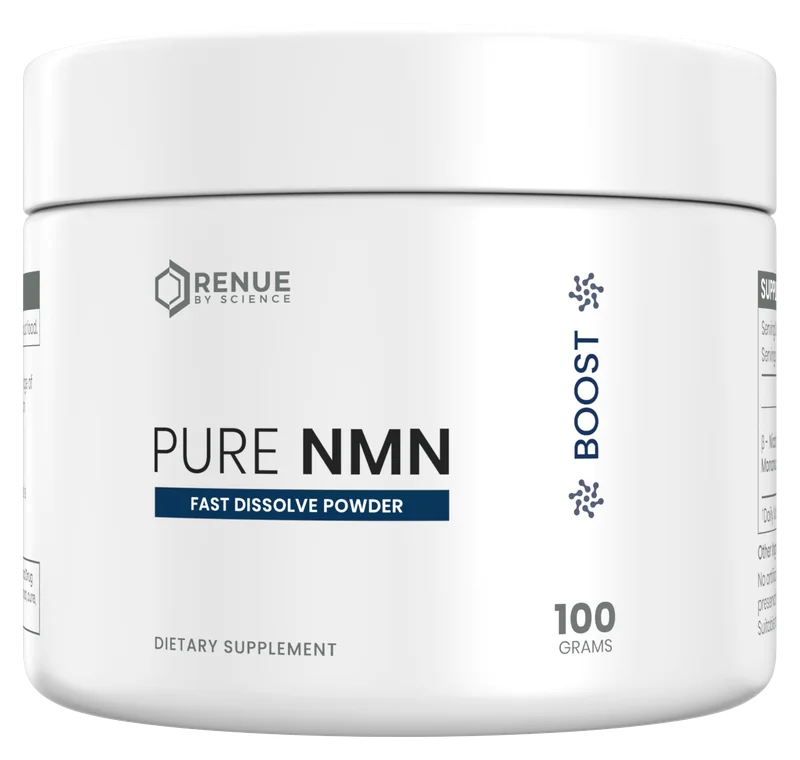 NMN Pure Powder500 mg per scoop; 200 servings per container; see the price table | powder | 500 mg | 200 | $54.95 | $0.27 | $0.27 |
One-time purchase prices from Renue By Science, checked November 22, 2026. Prices change; the store shows the current one. Cost per 500 mg uses the main active ingredient.
Show the scienceStudy-by-study table: 8 studies, design, dose and grade
The evidence
Every study cited in this article. Grades: A human RCT, meta-analysis or systematic review; B small, pilot or observational human study.
| Study | Design | People | Dose / duration | Result | Grade | Source |
|---|---|---|---|---|---|---|
| Fukamizu 2022[1] | RCT | 31 healthy adults aged 20-65 (NMN and placebo groups)n = 31 | 1,250 mg once daily · up to 4 weeks | No changes beyond normal physiological variation in blood, urine and body measures; no severe adverse events. | A | PubMed 36002548 |
| Yi 2023[2] | RCT | 80 healthy middle-aged adults (NMN and placebo groups)n = 80 | 300, 600 or 900 mg once daily · 60 days | No safety issues and well tolerated up to 900 mg; blood NAD+ rose at every dose, highest at 600 and 900 mg; six-minute walking distance rose more than on placebo. | A | PubMed 36482258 |
| Pencina 2023[3] | RCT | 32 overweight or obese adults aged 55-80 (NMN and placebo groups)n = 32 | 1,000 mg MIB-626 (NMN) once or twice daily · 14 days | Well tolerated with similar adverse-event frequency across groups; blood NAD+ rose in a dose-related way. | A | PubMed 35182418 |
| Katayoshi 2023[4] | RCT | 36 healthy middle-aged adults (NMN and placebo groups)n = 36 | 125 mg twice a day (250 mg/day) · 12 weeks | Well tolerated with no adverse events; serum nicotinamide, an NAD+ metabolite, was higher than in the placebo group. | A | PubMed 36797393 |
| Yamaguchi 2024[5] | pilot | 11 healthy middle-aged Japanese men (single-arm, open-label)n = 11 | 250 mg/day (two 125 mg capsules once daily) · 8 weeks | Well tolerated; NAD+ in peripheral blood mononuclear cells rose over the eight weeks. | B | PubMed 38191197 |
| Li 2023[6] | pilot | not reported | 1 g of an NAD+ precursor within combined metabolic activator formulations · 1 day | Niacin caused a flushing reaction; the NMN, NR and nicotinamide formulations boosted NAD+ products. | B | PubMed 37271226 |
| Yang 2026[7] | meta-analysis | 15 randomized trials in adults, 10 in the safety analyses | 250-2,000 mg/day · 14 days to 24 weeks | NMN did not increase overall, serious, withdrawal-related or system-specific adverse events and did not significantly raise ALT or AST. | A | PubMed 42514320 |
| Gallagher 2026[8] | systematic review | 113 studies: 33 human, 80 rodent | not reported | In human studies, oral NMN and NR were generally well tolerated over weeks to months. | A | PubMed 41655607 |
NMN Pure Powder: the trade-offs
Why people choose it
- 500 mg NMN per scoop, 200 servings per 100 g
- Plain NMN with no other ingredients listed
- Can be swallowed in water, the way the NMN trials gave it
Things to know
- You measure each scoop yourself
Support our research
Related

References
View all 8 cited studies
- Fukamizu Y, Uchida Y, Shigekawa A, et al. (2022). Safety evaluation of β-nicotinamide mononucleotide oral administration in healthy adult men and women. Sci Rep. PubMed 36002548
- Yi L, Maier AB, Tao R, et al. (2023). The efficacy and safety of β-nicotinamide mononucleotide (NMN) supplementation in healthy middle-aged adults: a randomized, multicenter, double-blind, placebo-controlled, parallel-group, dose-dependent clinical trial. Geroscience. PubMed 36482258
- Pencina KM, Lavu S, Dos Santos M, et al. (2023). MIB-626, an Oral Formulation of a Microcrystalline Unique Polymorph of β-Nicotinamide Mononucleotide, Increases Circulating Nicotinamide Adenine Dinucleotide and its Metabolome in Middle-Aged and Older Adults. J Gerontol A Biol Sci Med Sci. PubMed 35182418
- Katayoshi T, Uehata S, Nakashima N, et al. (2023). Nicotinamide adenine dinucleotide metabolism and arterial stiffness after long-term nicotinamide mononucleotide supplementation: a randomized, double-blind, placebo-controlled trial. Sci Rep. PubMed 36797393
- Yamaguchi S, Irie J, Mitsuishi M, et al. (2024). Safety and efficacy of long-term nicotinamide mononucleotide supplementation on metabolism, sleep, and nicotinamide adenine dinucleotide biosynthesis in healthy, middle-aged Japanese men. Endocr J. PubMed 38191197
- Li X, Yang H, Jin H, et al. (2023). The acute effect of different NAD+ precursors included in the combined metabolic activators. Free Radic Biol Med. PubMed 37271226
- Yang W, Huang J, Tang Z, et al. (2026). Safety and Metabolism-Related Outcomes of Oral Nicotinamide Mononucleotide Supplementation in Adults: A Systematic Review and Meta-Analysis. Nutrients. PubMed 42514320
- Gallagher C, Emmanuel OO (2026). NAD⁺ supplementation for anti-aging and wellness: A PRISMA-guided systematic review of preclinical and clinical evidence. Ageing Res Rev. PubMed 41655607