NMN: blood NAD+ outcomes across forms and doses
Does a bigger NMN dose raise NAD+ more? In an 80-adult trial, NAD+ was highest at 600 and 900 mg
Does more NMN mean more NAD+? In a 60-day trial of 80 adults, every dose raised blood NAD+ and walking distance, highest at 600 and 900 mg; responses varied widely by person.
Reader-supported: this page has affiliate links to Renue By Science. If you buy through them we earn a commission, which funds our research. We choose what to cover independently. How we’re funded
Article info
How we made this. Made with AI and checked against every study we cite. It is not medical advice.
Updated:
How we check · Methodology · Is NMN legal in US supplements? · Corrections · How we’re funded
Evidence: 10 studies, 10 in humans.
The evidence
412
adults in 9 pooled trials
10 in humans · 10 grade A, the strongest
NMN raised blood NAD+ in every trial that measured it
Figure 1. What the trials found for each outcome, as each study's abstract reports it. The centre line is no change: a dot on it means the study found no measurable change, a bar to the right shows the size of the improvement it reported (small, moderate or large), and a dashed band means the studies disagree or gave no size.
Source: Healthspan Post summary of the cited studies (PubMed).
In a 60-day trial of 80 healthy middle-aged adults, 300, 600 and 900 mg of NMN a day each raised blood NAD+ and six-minute walking distance more than placebo, with the highest NAD+ and the longest walks at 600 and 900 mg (Yi 2023). A 2025 meta-analysis of nine trials in 412 middle-aged and older adults pooled a small improvement in gait speed and a lower liver-enzyme marker (Wang 2025), and a 2026 analysis of the same 80-person trial found a higher blood NAD+ level tracked with a small rise in red-blood-cell count (Kuerec 2026). Results on gait speed are mixed: a second 2025 meta-analysis, in adults over 60, found no effect (Prokopidis 2025).
Does a bigger dose raise NAD+ more?
The question a buyer asks is plain: does a bigger dose give a bigger rise? In a randomized, double-blind, placebo-controlled trial, 80 healthy middle-aged adults took 300, 600 or 900 mg of NMN once a day, or a placebo, for 60 days. Blood NAD+ rose significantly above both baseline and placebo at 30 and 60 days in every dose group (Yi 2023), and it was highest in the 600 and 900 mg groups. Across all three NMN groups, the distance walked in a six-minute test was significantly greater than on placebo at both 30 and 60 days, and longest in the 600 and 900 mg groups. Self-rated general health on the SF-36 survey also improved more than on placebo in all three groups, except the 300 mg group at day 30. Blood biological age stayed unchanged in the NMN groups while it rose in the placebo group, a significant difference, and the supplement was well tolerated, with no safety signal on adverse-event monitoring. The authors conclude the benefit on NAD+ and physical performance peaked at 600 mg a day.
Show the data behind this chart
| Study | Year | People (n) | Grade | In humans |
|---|---|---|---|---|
| Yi 2023 | 2023 | 80 | A | Yes |
| Kuerec 2024 | 2024 | 80 | A | Yes |
| Wang 2025 | 2025 | 412 | A | Yes |
| Morifuji 2024 | 2024 | 60 | A | Yes |
| Liao 2021 | 2021 | 48 | A | Yes |
| Christen 2026 | 2026 | 65 | A | Yes |
| Prokopidis 2025 | 2025 | not reported | A | Yes |
| Pencina 2023 | 2023 | 30 | A | Yes |
| Yoshino 2021 | 2021 | not reported | A | Yes |
| Kuerec 2026 | 2026 | 80 | A | Yes |
Figure 2. Every study cited in this article, by year published and number of people studied. Color shows the evidence grade. Studies that reported no sample size sit in the separate strip below the chart.
Source: Healthspan Post analysis of the 10 studies cited in this article (PubMed).
A post-hoc analysis of a double-blind trial in 80 adults aged 40 to 65, on the same three doses for 60 days, asked a sharper question: how much of the NAD+ rise did each person get, and did it track with outcomes? The NAD+ change was dose-dependent, but it varied a lot between individuals, with a within-group coefficient of variation of 29.2 to 113.3 percent. A larger NAD+ change was associated with a longer six-minute walk and a better SF-36 score; the median NAD+ change linked to those gains was 15.7 nmol/L for the walk and 13.5 nmol/L for the SF-36 score (Kuerec 2024). That spread is why “does my dose do anything?” is a personal question: the same pill does not do the same thing for everyone.
For the dose’s effect on metabolism, the same trial measured an insulin-resistance marker and found no difference from placebo at 60 days. So the gains that trial supports are on blood NAD+, walking distance and self-rated health, not on insulin resistance.
What a dose does across the trials
A 2025 meta-analysis pooled nine randomized trials with 412 middle-aged and older adults and found a statistically significant improvement in gait speed (a standardized mean difference of 0.34) and a lower level of the liver-enzyme marker ALT (a standardized mean difference of −0.29), with the strongest effect on an insulin-resistance measure at the smaller doses (Wang 2025). In a randomized, placebo-controlled trial of 60 older adults, 250 mg a day for 12 weeks raised blood NAD+ and its metabolites, gave a shorter 4-meter walk time and better sleep quality than placebo, though the primary stepping test did not differ (Morifuji 2024). In a randomized, double-blind trial of 48 amateur runners who trained five to six times a week, 300, 600 or 1,200 mg a day for six weeks raised oxygen uptake and power at the ventilatory thresholds more at the middle and high doses than placebo, while VO2max, oxygen pulse and peak power did not differ (Liao 2021). And in a 14-day randomized trial of 65 healthy adults, NMN and nicotinamide riboside each raised circulatory NAD+ to a similar degree, while plain nicotinamide did not (Christen 2026).
Pencina 2023 two 500 mg tablets twice a day
4 weeksMeasured: blood NAD+, physical performance, weight, blood pressure, cholesterol
Liao 2021 300, 600 or 1,200 mg a day
6 weeksMeasured: oxygen uptake, ventilatory-threshold power, VO2max, peak power
Yi 2023 300, 600 or 900 mg a day
60 daysMeasured: blood NAD+, six-minute walk, biological age, self-rated health
Morifuji 2024 250 mg a day
12 weeksMeasured: blood NAD+ and metabolites, 4-meter walk, sleep quality
Figure 3. The dose each human trial used and how long it lasted, as its abstract reports. Longer bars mean longer trials.
Source: Healthspan Post summary of the cited trials (PubMed).
The pooled results on gait speed disagree. A 2025 meta-analysis of trials in adults with a mean age of 60.9 to 83 found NMN had no significant effect on muscle mass, hand-grip strength, gait speed or the five-time chair stand (Prokopidis 2025). The metabolic results that did appear, insulin sensitivity and signaling in postmenopausal women with prediabetes (Yoshino 2021) and lower body weight, diastolic blood pressure and cholesterol in adults who were overweight or obese on 2,000 mg a day (Pencina 2023), came from specific groups and were not tested in healthy, lean adults, so we will not claim NMN lowers blood sugar or blood pressure for anyone.
How would you know your dose is doing something?
The most direct signal is your own blood NAD+. In a 2026 post-hoc analysis of the same 80-person trial, every 1 nM higher baseline NAD+ was associated with small shifts in the blood, higher lymphocytes and lower neutrophils, and every 1 nM increase in NAD+ during the trial was associated with a small rise in hemoglobin, red-blood-cell count and mean corpuscular hemoglobin concentration, which the authors say potentially indicates enhanced oxygen-carrying capacity. These are associations from one trial, not cause-and-effect (Kuerec 2026).
Because the NAD+ rise varied so much between people on the same dose, the authors of the 2024 analysis say monitoring blood NAD+ can help tailor a personal dose (Kuerec 2024). In the 60-day trial, NAD+ was measured at the start, at day 30 and at day 60 (Yi 2023), so the useful signal is the change from your starting level, not a single reading.
Figure 4. The molecule is the same in every form; the form changes the dose format, convenience and cost per dose. Few human trials compare forms head to head.
Source: Healthspan Post, from product labels.
What the evidence does not show
No trial in our evidence compared delivery forms, liposomal, sublingual, enteric or plain, on any outcome, so we cannot say one form raises NAD+ more than another. Morning-versus-evening or with-food-versus-without is also not settled by any human trial we retrieved.
Who should check first
- Pregnant or breastfeeding women, and people under 18, because the trials did not study them.
- People who take prescription medicine, who should check with a clinician first.
The product
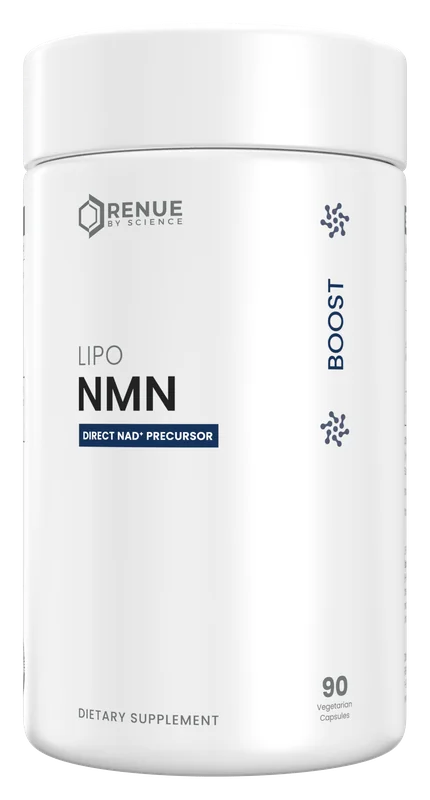
NMN Liposomal Capsules give 500 mg of NMN from two capsules a day, with 45 servings. The trials used 250 to 2,000 mg a day, so a 500 mg serving sits inside that range. Renue says NMN is a direct precursor to NAD+, and that its liposomes protect the NMN through digestion for a slower, more sustained release. See NMN Liposomal Capsules
Figure 5. NAD+ is a helper molecule for energy metabolism and a fuel for enzymes that maintain cells; several of those enzymes use it up as they work.
Source: Covarrubias et al., Nature Reviews Molecular Cell Biology, 2021 (PubMed 33353981).
What we checked
- Lab result vs label
- 101.6% of the NMN on the label. Lot 062827351, Summit Nutritional Laboratories
- Cost per 500 mg
- $1.44 Median across Renue's NMN range: $0.92
- Human studies in this article
- 10 10 randomized trials or meta-analyses (grade A)
COA reviewed October 10, 2026: we read the certificates of analysis Renue publishes; we don't run lab tests ourselves. Every report we checked · Price index
Show the scienceStudy-by-study table: 10 studies, design, dose and grade
The evidence
Every study cited in this article. Grades: A human RCT or meta-analysis; B small, pilot or observational human study; C animal or cell study.
| Study | Design | People | Dose / duration | Result | Grade | Source |
|---|---|---|---|---|---|---|
| Yi 2023[1] | RCT | 80 healthy middle-aged adultsn = 80 | 300, 600 or 900 mg/day60 days | Blood NAD+ rose at every dose above baseline and placebo, highest at 600 and 900 mg; six-minute walk farther than placebo at 30 and 60 days at every dose, longest at 600 and 900 mg; better SF-36 self-rated health than placebo; blood biological age unchanged on NMN while it rose on placebo; insulin resistance unchanged; well tolerated | A | PubMed 36482258 |
| Kuerec 2024[2] | RCT | 80 healthy adults aged 40-65n = 80 | 300, 600 or 900 mg/day60 days | NAD+ change was dose-dependent with a wide within-group coefficient of variation (29.2 to 113.3 percent); a larger NAD+ change was associated with a longer six-minute walk and a better SF-36 score | A | PubMed 38430946 |
| Wang 2025[3] | meta-analysis | 412 middle-aged and older adults in 9 trialsn = 412 | not reportednot reported | Improved gait speed (standardized mean difference 0.34); lower liver-enzyme ALT (standardized mean difference -0.29); strongest insulin-resistance effect at the smaller doses | A | PubMed 39185644 |
| Morifuji 2024[4] | RCT | 60 older adultsn = 60 | 250 mg/day12 weeks | Blood NAD+ and its metabolites rose; shorter 4-meter walk time and better sleep quality than placebo; the primary stepping test did not differ | A | PubMed 38789831 |
| Liao 2021[5] | RCT | 48 amateur runnersn = 48 | 300, 600 or 1,200 mg/day6 weeks | Oxygen uptake and ventilatory-threshold power rose more at the 600 and 1,200 mg doses than placebo; VO2max, oxygen pulse and peak power did not differ | A | PubMed 34238308 |
| Christen 2026[6] | RCT | 65 healthy adultsn = 65 | not reported14 days | NMN and nicotinamide riboside raised circulatory NAD+ by similar amounts; plain nicotinamide did not | A | PubMed 41540253 |
| Prokopidis 2025[7] | meta-analysis | adults with a mean age of 60.9 to 83n = not reported | not reportednot reported | No significant effect of NMN on muscle mass, hand-grip strength, gait speed or the five-time chair stand | A | PubMed 40275690 |
| Pencina 2023[8] | RCT | 30 adults aged 45 and over who were overweight or obesen = 30 | two 500 mg tablets twice daily28 days | Circulating NAD+ and its metabolites rose; body weight, diastolic blood pressure and cholesterol fell more than placebo; muscle strength, fatigability and aerobic capacity did not differ | A | PubMed 36740954 |
| Yoshino 2021[9] | RCT | postmenopausal women with prediabetes who were overweight or obesen = not reported | not reported10 weeks | Muscle insulin sensitivity and insulin signaling rose vs placebo, in a prediabetic group not tested in lean healthy adults | A | PubMed 33888596 |
| Kuerec 2026[10] | RCT | 80 healthy middle-aged adultsn = 80 | 300, 600 or 900 mg/day60 days | Every 1 nM higher NAD+ was associated with small shifts in the blood, higher lymphocytes and lower neutrophils; a higher NAD+ level tracked with a small rise in red-blood-cell count | A | PubMed 41162813 |
NMN Liposomal Capsules: the trade-offs
Why people choose it
- 500 mg NMN per 2-capsule serving
- Capsules: no measuring or taste
- Liposomes are designed for slower, sustained release (Renue's description)
Things to know
- A serving is 2 capsules; one bottle of 90 is 45 servings
- No human trial we have reviewed tested liposomal NMN against plain NMN
*These statements have not been evaluated by the Food and Drug Administration. This product is not intended to diagnose, treat, cure, or prevent any disease.
Related
How do NMN and NR become NAD+? In human trials, both raised blood NAD+
How do NMN and NR become NAD+? In human trials, both raised blood NAD+
NR and blood NAD+
Nicotinamide riboside, an NAD+ precursor vitamin: does swallowing it raise NAD+? In human trials, blood NAD+ rose
NMN and NAD+ for beginners
New to NMN and NAD+? A routine built on the human trials

References
- Yi L, Maier AB, Tao R, et al. (2023). The efficacy and safety of β-nicotinamide mononucleotide (NMN) supplementation in healthy middle-aged adults: a randomized, multicenter, double-blind, placebo-controlled, parallel-group, dose-dependent clinical trial. Geroscience. PubMed 36482258
- Kuerec AH, Wang W, Yi L, et al. (2024). Towards personalized nicotinamide mononucleotide (NMN) supplementation: Nicotinamide adenine dinucleotide (NAD) concentration. Mech Ageing Dev. PubMed 38430946
- Wang JP, Wang L, Wang T, et al. (2025). Effects of Nicotinamide Mononucleotide Supplementation on Muscle and Liver Functions Among the Middle-aged and Elderly: A Systematic Review and Meta-analysis of Randomized Controlled Trials. Curr Pharm Biotechnol. PubMed 39185644
- Morifuji M, Higashi S, Ebihara S, et al. (2024). Ingestion of β-nicotinamide mononucleotide increased blood NAD levels, maintained walking speed, and improved sleep quality in older adults in a double-blind randomized, placebo-controlled study. Geroscience. PubMed 38789831
- Liao B, Zhao Y, Wang D, et al. (2021). Nicotinamide mononucleotide supplementation enhances aerobic capacity in amateur runners: a randomized, double-blind study. J Int Soc Sports Nutr. PubMed 34238308
- Christen S, Redeuil K, Goulet L, et al. (2026). The differential impact of three different NAD+ boosters on circulatory NAD and microbial metabolism in humans. Nat Metab. PubMed 41540253
- Prokopidis K, Moriarty F, Bahat G, et al. (2025). The Effect of Nicotinamide Mononucleotide and Riboside on Skeletal Muscle Mass and Function: A Systematic Review and Meta-Analysis. J Cachexia Sarcopenia Muscle. PubMed 40275690
- Pencina KM, Valderrabano R, Wipper B, et al. (2023). Nicotinamide Adenine Dinucleotide Augmentation in Overweight or Obese Middle-Aged and Older Adults: A Physiologic Study. J Clin Endocrinol Metab. PubMed 36740954
- Yoshino M, Yoshino J, Kayser BD, et al. (2021). Nicotinamide mononucleotide increases muscle insulin sensitivity in prediabetic women. Science. PubMed 33888596
- Kuerec AH, Wang W, Fokke KDM, et al. (2026). Association between blood nicotinamide adenine dinucleotide levels and blood laboratory parameters at baseline and after nicotinamide mononucleotide supplementation in middle-aged healthy individuals: post hoc analysis of a randomized, double-blinded, placebo-controlled clinical trial. Geroscience. PubMed 41162813